
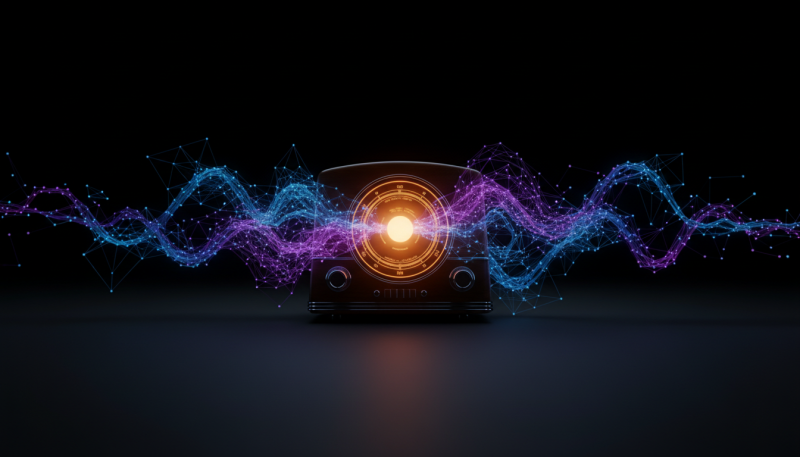
It starts with a familiar sound.
Static. A dial turning. The sudden burst of a voice intro followed by the opening riff of a song you love.
For over a century, radio has been the background track to our lives. It’s been the voice in the car, the companion in the kitchen, and the trusted source of breaking news.
But if you think radio is just antennas, transmitters, and a guy named “Crazy Dave” shouting into a microphone, you’re living in the past.
Something massive is shifting beneath our feet.
The industry is undergoing a metamorphosis that is as terrifying as it is exhilarating.
We aren’t just talking about better playlists or clearer signals. We are talking about a fundamental rewrite of the DNA of broadcasting.
The culprit? Artificial Intelligence.
But wait, don’t tune out.
This isn’t another dry tech manual about algorithms. This is the story of how AI radio technology is saving a medium that naysayers have been trying to bury for decades. It’s about how the music industry AI landscape is merging with traditional broadcast to create something entirely new.
And if you work in audio, music, or media?
This is your wake-up call.
Here is exactly how the future of broadcasting is being written, right now, by lines of code that are learning to sing.
The Death of “Spray and Pray” Broadcasting
Remember how radio used to work?
A Program Director would look at charts, trust their gut, and blast the same signal out to millions of people. If you liked rock and they played pop, you switched the dial. It was a “spray and pray” model. Hope for the best.
That model is dead.
It’s being replaced by hyper-precision.
The Data-Driven DJ
Today, AI is analyzing listener behavior with a granularity that human brains simply cannot process. We aren’t just tracking which songs are skipped; we are tracking why.
Is the tempo too slow for 8:00 AM on a Tuesday? Is the transition between the ad break and the song too jarring?
AI tools are currently ingesting terabytes of data regarding:
- Listener retention rates down to the second.
- Geographic preferences mapped against local weather and traffic.
- Sentiment analysis of social media discussions regarding specific tracks.
Here’s the best part:
This data doesn’t just sit in a spreadsheet. It actively programs the station.
AI algorithms can now dynamically adjust playlists in real-time. If the AI detects that listeners in a specific demographic are dropping off, it can instantly swap the next track for a higher-retention “banger” to stop the bleeding.
Pro-Tip for Program Directors: Stop viewing data as a report card. View it as a co-pilot. Use tools like Veritonic or Chartmetric to understand the emotional resonance of your playlist, not just the spin count.
The Rise of the Synthetic Host
Now, let’s address the elephant in the room.
The robot in the studio.
When we talk about AI radio technology, the most controversial topic is undoubtedly the AI DJ.
You’ve likely heard of Spotify’s “DJ X,” or Futuri’s “RadioGPT.” These aren’t just text-to-speech engines reading the weather. These are sophisticated Generative AI models that possess personality, humor, and localized knowledge.
They can introduce a song, crack a joke about the local sports team losing last night, and mention that traffic is backed up on I-95.
Is This the End of Human Talent?
It’s easy to panic. It’s easy to think, “Great, there goes my job.”
But let me offer a different perspective.
The Slippery Slope of Efficiency:
- Radio has always been a 24/7 medium.
- Humans need sleep. Humans get sick. Humans burn out.
- Because of this, overnight slots and weekends are often filled with pre-recorded voice tracking or syndicated content that feels generic.
Enter the AI DJ.
AI allows a local station to sound live and local at 3:00 AM on a Sunday. It can read a script about a local fire or a charity event instantly, keeping the station relevant when the human staff is asleep.
This doesn’t replace the morning show star. It replaces the dead air.
It elevates the baseline quality of the broadcast, ensuring that the station never sounds “canned.”
Key Takeaway: The future of broadcasting isn’t Human vs. AI. It is Human plus AI. The stations that win will use AI to handle the grunt work (weather, time checks, basic intros) so their human talent can focus on deep storytelling, interviews, and community connection.
Hyper-Personalization: The “Segment of One”
Let me explain why streaming services scared the life out of radio executives.
It wasn’t just the on-demand aspect. It was the personalization. My Spotify “Discover Weekly” feels like it was made for me. Traditional radio felt like it was made for “Males 18-34.”
But AI radio technology is leveling the playing field.
We are moving toward a hybrid model often called “Addressable Audio.”
Imagine you are listening to a broadcast stream through an app or a smart speaker. The song playing is the same for everyone. But when the break comes?
- Listener A (A parent in the suburbs): Hears a gentle intro from an AI host about school closings and an ad for a minivan.
- Listener B (A student in the city): Hears a high-energy intro about a concert tonight and an ad for an energy drink.
This is the “Segment of One.”
The Tech Behind the Magic
This is achieved through Dynamic Ad Insertion (DAI) and generative voice technology. The AI analyzes the user’s IP address, device ID, and listening history to stitch together a seamless, personalized broadcast in real-time.
It feels live. It feels shared. But it is tailored specifically to you.
Why does this matter?
Because relevance drives retention. If the content speaks directly to the listener’s current reality, they are statistically less likely to turn it off.
Revolutionizing Revenue: Automated Ad Placement
Let’s talk money.
Because at the end of the day, radio is a business.
For decades, ad buying in radio was inefficient. It involved fax machines (yes, really), handshakes, and blanket coverage. You bought an ad, and it played to everyone, whether they were your target customer or not.
Music industry AI and ad-tech are changing the game.
Programmatic Audio Advertising
Just like you buy ads on Facebook or Google, you can now buy audio inventory programmatically. AI algorithms bid on ad slots in milliseconds based on the listener profile.
- Efficiency: No more wasted impressions.
- Creativity: AI can now generate thousands of variations of an ad script.
- Variation 1: “It’s raining in Seattle, come get a hot coffee.”
- Variation 2: “It’s sunny in Miami, come get an iced latte.”
The AI detects the weather in the listener’s location and serves the correct audio file instantly.
But wait, there’s more:
AI is also optimizing where the ads go.
It analyzes the energy levels of the songs. It knows better than to place a jarring car dealership scream-ad right after a somber ballad. It finds the “energy match” to ensure the flow of the station isn’t disrupted, keeping listeners engaged through the break.
Actionable Step for Sales Teams: Move away from selling “spots and dots.” Start selling “audience segments and context.” Use AI tools to prove to advertisers that their message is hitting the right ears at the exact right moment.
Content Creation on Steroids
If you are a producer, you know the grind.
Show prep. Scriptwriting. Audio editing. Social media clips. It’s a never-ending hamster wheel of content creation.
Here is where AI becomes your best friend.
1. The Super-Powered Producer
Tools like ChatGPT and Claude are already being used to generate show prep.
- “Give me 5 controversial topics for a morning show discussing local politics.”
- “Write a 30-second script introducing the new Taylor Swift song.”
2. Audio Post-Production
Remember spending hours removing background noise or “ums” and “ahs” from an interview?
AI tools like Descript or Adobe Podcast do this in seconds. They transcribe the audio, and you edit the text like a Word document. Delete a word in the text, and it deletes the audio.
3. Social Media Amplification
Radio lives on the air, but it survives on social media.
AI video tools can now take a 4-hour radio show, listen to it, identify the 3 most viral moments, clip them, caption them, and format them for TikTok and Instagram Reels.
Zero human intervention required until the final approval.
Think about the ROI here.
What used to take a producer 4 hours now takes 15 minutes. That frees up the producer to do what they do best: be creative.
The Ethical Dilemma: Authenticity vs. Automation
We have to look at the dark side.
As we sprint toward this future of broadcasting, we encounter a massive hurdle: Trust.
Radio has always been the “authentic” medium. The connection between a listener and a host is intimate. It’s built on the belief that there is a real person on the other end of the line.
If listeners find out they’ve been pouring their hearts out to a chatbot, or that the “live” request show was pre-generated by a server farm, the backlash could be severe.
The Uncanny Valley of Audio
There is a risk of radio becoming “soulless.”
If AI radio technology makes everything too perfect—perfect transitions, perfect pitch, perfect playlist flow—it loses the grit that makes it human.
Pro-Tip for Broadcasters: Label your AI. Be transparent.
If you are using an AI host for the overnight shift, give it a name like “Robo-Rick” or explicitly state it’s an AI experiment. Audiences appreciate transparency. They punish deception.
The Road Ahead: What the Future Holds
So, where is this all going?
If we look at the trajectory of music industry AI, we can see a few clear trends emerging for the next 5 years.
1. Interactive Voice Radio
With the rise of smart speakers and voice assistants in cars, radio will become two-way.
- Listener: “Hey Radio, tell me more about this artist.”
- Station (AI): Pauses the music, gives a bio, and resumes.
- Listener: “I don’t like this song.”
- Station (AI): Skips it and notes the preference.
2. Generative Music
We are already seeing AI that can generate music. Soon, we might have stations that play music that doesn’t exist yet, generated on the fly to match the listener’s biometric data (heart rate, stress levels).
3. The Democratization of Broadcasting
High-quality AI tools are becoming cheap. This means a kid in a basement can create a radio station that sounds as professional as a major network conglomerate. The barrier to entry is collapsing. Competition will skyrocket.
Conclusion: Adapt or Fade Away
The radio isn’t dying. It is shedding its skin.
We are witnessing the most significant shift in audio since the invention of FM.
AI radio technology is not a villain coming to steal jobs. It is a tidal wave. You can either learn to surf, or you can get crushed by the water.
For the professionals reading this—the producers, the DJs, the tech directors—your value is no longer in pushing buttons. A robot can push buttons better than you.
Your value is in curation, empathy, and connection.
AI can pick the perfect song, but it can’t cry with a listener who just lost a parent.
AI can read the news, but it can’t feel the outrage of a community.
AI can analyze data, but it can’t predict the cultural zeitgeist before it happens.
Here is the bottom line:
The future of broadcasting belongs to those who use AI to handle the logistics, so they can focus on the humanity.
Are you ready to evolve?
The dial is turning. Don’t get left in the static.
Enjoyed this deep dive into the future of audio? We release cutting-edge insights on media technology every week. Subscribe to our newsletter below to stay ahead of the curve and receive our free guide: “5 AI Tools Every Radio Producer Needs Right Now.”